The NFL season comes down to one game and for Draftstars Daily Fantasy NFL players, Super Bowl LX presents the purest single-game puzzle of the year. With just the Seattle Seahawks and New England Patriots on the slate, roster construction becomes less about player discovery and more about storytelling, correlation, and Captain selection.
Unlike multi-game slates where you can hedge outcomes, a one-game Draftstars contest forces commitment. You must roster one Captain (1.5x fantasy points) and five FLEX players, with no D/ST available, meaning every lineup decision directly reflects how you believe the game will unfold. Ownership condenses aggressively, ceilings matter more than floors, and a single touchdown swing can separate first from 5,000th.
From a DFS lens, this slate rewards players who understand how to leverage Captain builds — whether that’s eating the chalk with a high-priced alpha, or captaining a lower-owned, lower-salary player with real upside to unlock multiple studs in FLEX. Below, we break down every relevant position, explain how to approach Captain routes, and outline how to attack Super Bowl LX correctly on Draftstars.

NFL 2025-26 Daily Fantasy Tips: Super Bowl LX
Quarterbacks
Drake Maye — $17,230
Maye enters the Super Bowl as the highest raw-ceiling quarterback on the slate, and his fantasy profile justifies the premium salary. During the regular season, Maye threw for 4,394 yards (4th in the NFL) with 31 passing touchdowns (3rd) against just 8 interceptions, while adding meaningful rushing production to stabilize his DFS floor.
From a single-game fantasy perspective, Maye’s value comes from volume certainty. New England’s offense runs through his arm, particularly in neutral or trailing scripts, and he has shown the ability to post strong fantasy scores even when pressured. Seattle’s defence can generate disruption, but they also allow intermediate completions — an area where Maye thrives.
Maye is viable in both FLEX and Captain builds. As Captain, you’re betting on New England leaning pass-heavy near the goal line. In FLEX, he fits best in Patriots-control or shootout-adjacent lineups where multiple New England pass-catchers are involved.
How to play it: Maye works best when paired with at least one Patriots pass-catcher, and he can be captained in lineups that fade Seattle’s rushing control.
Sam Darnold — $14,490
Darnold is the salary-adjusted upside quarterback on this slate and a key tournament pivot off Maye. He finished the regular season with 4,048 passing yards (5th) and 25 passing touchdowns, though interceptions (14) remain part of the package. For DFS, that volatility is not a bug — it’s the feature.
Seattle’s offensive environment leans into Darnold’s fantasy strengths. With Kenneth Walker commanding defensive attention, Darnold benefits from play-action and layered route concepts that allow his primary receivers to generate explosive gains. If Seattle falls behind or trades scores, Darnold’s pass attempts spike — and so does his fantasy output.
Darnold is rarely optimal without correlation. His ceiling games are directly tied to his receivers producing at elite levels, making him a strong FLEX play and a lower-owned Captain option in Seahawks-on-top scripts.
How to play it: Pair Darnold with at least one Seahawks pass-catcher and consider him as Captain in builds that fade Walker dominance.
QB Strategy
On a one-game slate, quarterbacks are not automatic Captains — they’re leverage pieces.
- Maye Captain = Patriots lean pass-heavy near the goal line
- Darnold Captain = Seahawks win through efficiency and explosive plays
- QB in FLEX works best when paired with pass-catchers and a clear game script
Avoid naked quarterbacks. Correlation is everything when the player pool is this small.
Running Backs
Kenneth Walker III — $16,150
Walker is the most game-script-sensitive running back on the slate, but his fantasy ceiling remains massive. He finished the regular season with 221 carries for 1,027 yards, adding 31 receptions and consistent red-zone usage. When Seattle plays from ahead or remains balanced, Walker’s touch floor becomes extremely stable.
From a DFS standpoint, Walker is most attractive in lineups that assume Seattle control tempo. His physical running style wears down defences, and his ability to break tackles gives him access to long touchdowns — a slate-breaking outcome in single-game formats.
Walker is viable as both Captain and FLEX. Captain Walker builds typically fade heavy Darnold passing volume and instead lean into Seattle efficiency and clock control.
TreVeyon Henderson — $3,920
Henderson is the key salary-relief back on this slate, and his appeal lies in efficiency rather than volume. While his snap share is limited, Henderson has shown burst and pass-game utility when given opportunities, making him viable in negative game scripts for New England.
At sub-$4k, Henderson does not need 20 touches. A handful of receptions or a change-of-pace touchdown is enough to justify the price — and to unlock multiple high-salary FLEX plays elsewhere.
RB Strategy:
- Walker fits best in Seahawks-lead builds
- Henderson is a FLEX enabler for stars-and-scrubs lineups
- RB Captains should align tightly with game flow assumptions
Wide Receivers
Jaxon Smith-Njigba — $20,000
JSN is the highest-priced and highest-ceiling skill player on the slate, and the salary reflects reality. He finished the regular season with 119 receptions, a league-leading 1,793 receiving yards, and 10 touchdowns — elite production across every DFS-relevant metric.
His role is ideal for single-game DFS. JSN commands targets at all depths, wins after the catch, and remains heavily involved regardless of game script. If Seattle trails, his volume spikes. If Seattle leads, he still produces through efficiency.
JSN is the safest Captain on the slate, but also the most popular. Fading him entirely is risky; leveraging him through FLEX instead of Captain is often the sharper tournament play.
Cooper Kupp — $9,820
Kupp’s salary reflects a down season statistically (47 receptions, 593 yards, 2 TD), but that discount creates leverage. His role remains concentrated in high-value areas of the field, particularly on third downs and in the red zone.
In single-game DFS, veterans like Kupp can outscore salary expectations through situational usage, not raw volume. He fits best in Patriots-leaning builds or Seahawks coverage-tilt scenarios where JSN draws extra attention.
Mack Hollins — $5,990
Hollins is a classic single-game DFS role player. He runs high-leverage routes, sees red-zone looks, and blocks enough to stay on the field. While his target volume is modest, his touchdown equity is real — and that matters far more than raw receptions in this format.
WR Strategy:
- JSN is the premier Captain but also the chalk
- Kupp is leverage through discounted usage
- Hollins is a FLEX differentiator with TD equity
Tight Ends
Hunter Henry — $9,880
Henry is New England’s most reliable middle-of-the-field target and a consistent red-zone presence. He benefits directly from Maye’s willingness to attack linebackers and safeties, especially in condensed formations.
Henry’s fantasy value comes from touchdown probability, not yardage. In a Super Bowl environment where drives tighten near the goal line, that matters.
AJ Barner — $4,710
Barner quietly produced 52 receptions, 519 yards, and 6 touchdowns during the season — an excellent profile for a value tight end. His touchdown rate makes him particularly appealing in Seahawks stacks that fade Walker at Captain.
TE Strategy:
- Tight end is where differentiation is created
- Prioritize red-zone usage over athletic narratives
Final Thoughts
Super Bowl DFS isn’t about being clever — it’s about being coherent. Every lineup should tell a story, from Captain through FLEX. If Seattle controls the game, your roster should reflect that. If New England leans on Maye’s arm, your lineup must benefit fully.
Pick a script. Correlate properly. Embrace variance.
That’s how you win a one-game slate.
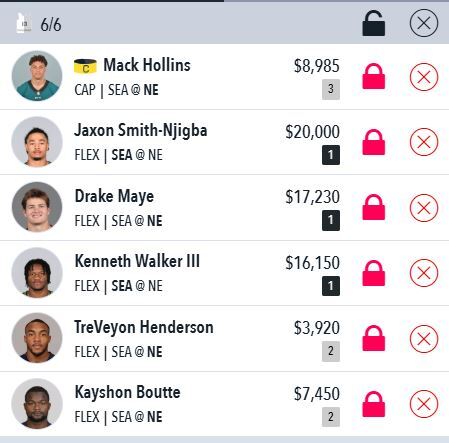
Suggested NFL Super Bowl Draftstars Lineup