Week 1 provided plenty of fireworks for NFL Daily Fantasy players, and we now head into Week 2 with our first meaningful sample of 2026 usage to analyse. While one game is nowhere near enough to completely change our preseason opinions, snaps, touches, targets, and route participation can already reveal where Draftstars pricing may be slow to react.
The Monday morning Australian slate offers several appealing environments. Philadelphia heads to Tennessee after Jalen Hurts threw three touchdowns in the opener, while Carolina @ Atlanta features two backfields worth attacking after both teams produced significant fantasy numbers in Week 1. Buccaneers @ Browns offers another interesting matchup after Cleveland was comfortably beaten by Jacksonville, while Washington @ Dallas brings plenty of potential through the air after both teams lost their openers.
Week 2 is about finding the balance between what we believed entering the season and what Week 1 actually showed us. We shouldn't completely overhaul our expectations after 60 minutes of football, but when preseason assumptions are confirmed by strong usage, there is an opportunity to attack salaries before Draftstars fully adjusts.
Also the NFL Star returns at Draftstars this year with $30,000 up for grabs! You can find out all the important NFL Star details here.

NFL 2026-27 Daily Fantasy Tips: Week 2
Quarterbacks
Jalen Hurts - $16,840
Jalen Hurts didn't need enormous yardage to deliver in Philadelphia's 24-22 win over Washington, completing 19 of 31 passes for 203 yards and three touchdowns while adding 46 yards on the ground. That rushing involvement remains the foundation of his fantasy appeal, while three passing scores was an encouraging start under new offensive coordinator Sean Mannion.
The matchup gets considerably easier against Tennessee. The Titans conceded 230.5 passing yards per game last season and opened 2026 by allowing the Jets to score 23 points. Their pass rush also generated little pressure in Week 1, which is dangerous against a quarterback who becomes particularly difficult to contain when allowed time to escape the pocket.
Philadelphia is missing Landon Dickerson and Jeffery Simmons presents a genuine problem inside, but Hurts' dual-threat ability can overcome imperfect protection. At $16,840, we get one of the highest touchdown ceilings at the position without needing to reach the very top of the salary range.
Caleb Williams - $14,260
If Week 1 was any indication, the Caleb Williams breakout may be upon us. Williams torched Carolina for 269 passing yards and two touchdowns while adding 65 rushing yards and another two scores as Chicago piled up 59 points. It was exactly the type of dual-threat performance fantasy players have been waiting for.
The four touchdowns obviously aren't sustainable every week, but the rushing production matters. Williams' 65 yards on the ground provided the equivalent of substantial additional passing production before we even account for his two rushing touchdowns, giving him a much higher fantasy ceiling than a traditional pocket quarterback.
Minnesota presents a considerably tougher test than Carolina, so we shouldn't simply chase last week's box score. However, the Vikings allowed Green Bay to score 22 points in their opener, and Williams' ability to create outside structure gives him an answer when Minnesota brings pressure.
At $14,260, he's $2,580 cheaper than Hurts and offers similar dual-threat upside. That salary saving becomes extremely useful if we're trying to fit Bijan Robinson and premium receivers into the same lineup.
QB Strategy
Hurts and Williams represent two different ways to approach quarterback without sacrificing rushing upside. Hurts provides the more established floor and an excellent matchup against Tennessee, while Williams offers meaningful savings after demonstrating his ceiling in Week 1.
I'm still looking to correlate quarterbacks with their pass catchers where possible, but neither quarterback is completely dependent on stacking because both can generate significant fantasy production on the ground. Williams is particularly appealing in builds where the $2,580 saving allows an upgrade elsewhere. Hurts is the stronger raw play, but salary allocation across the entire lineup will ultimately determine which quarterback fits best.
Running Backs
Bijan Robinson - $19,430
Bijan Robinson is extremely expensive, but Week 1 demonstrated exactly why. In an Atlanta offence that managed only 238 total yards and 13 points against Pittsburgh, Robinson still produced 173 yards from scrimmage. He rushed for 83 yards and caught eight passes for another 90 yards and a touchdown, accounting for approximately 73% of Atlanta's total offense.
Now the matchup swings dramatically in his favour. Carolina was shredded by Chicago's backfield last week, allowing D'Andre Swift to rush for 124 yards and three touchdowns while Kyle Monangai also surpassed 100 rushing yards. The pair combined for four rushing touchdowns.
Robinson's receiving involvement also makes him extremely resistant to game script. He doesn't require Atlanta to establish a lead or even run the ball effectively to accumulate points.
The obvious issue is the $19,430 salary. You're sacrificing elsewhere to roster him, but there may not be another player on the slate who combines his workload, receiving role and matchup. If paying all the way up at running back, Bijan is the player I want.
Bucky Irving - $12,440
Bucky Irving didn't explode in Week 1, but his underlying usage was extremely encouraging. He played 61.5% of Tampa Bay's offensive snaps, handled 15 touches and produced 93 total yards against Cincinnati. More importantly, he controlled the passing down work, running a route on 58.3% of drop backs and accounting for a 25% target share while producing 48 receiving yards.
That receiving role immediately makes Irving interesting at $12,440. We aren't relying solely on rushing efficiency or Tampa Bay reaching the goal line for him to return value.
Cleveland's defence was comprehensively beaten by Jacksonville in Week 1, conceding 34 points. The Browns also allowed the fifth-highest explosive run rate and ninth-highest missed tackle rate among Week 1 defences.
Irving is therefore one of my favourite mid-range options. The workload isn't quite at elite workhorse level, but 15-plus touches with meaningful receiving usage in a favourable home matchup provides several different paths to production without forcing us to pay an RB1 salary.
Chuba Hubbard - $11,170
Lost among Carolina conceding 59 points last week was another encouraging workload for Chuba Hubbard. He played 67.7% of the offensive snaps, controlled all three of Carolina's redzone rushing attempts and ran a route on 58.1% of passing plays. He finished with 13 touches for 87 total yards while scoring both a rushing and receiving touchdown.
That usage is exactly what we want from an $11,170 running back. Carolina fell behind heavily and Hubbard still remained relevant because of his involvement in the passing game.
Atlanta's Week 1 run defence was impressive against Pittsburgh, but the larger sample isn't nearly as intimidating. The Falcons ranked 24th against the run last season, conceding 126.2 rushing yards per game.
There is some risk that Carolina's offense struggles away from home, but Hubbard doesn't require a positive game script. His redzone dominance and receiving involvement give him an excellent role for the salary, making him another strong mid-range option alongside Irving.
RB Strategy
Bijan is the clear premium target, but his $19,430 salary creates a genuine roster-construction decision. Irving and Hubbard both demonstrated enough receiving involvement in Week 1 that I'm comfortable using either as an RB2, or even pairing them together and spending heavily elsewhere.
The important takeaway from Week 1 is workload rather than touchdowns. Hubbard scoring twice was great, but his snap, route and redzone shares are more predictive going forward. Likewise, Irving's receiving usage is more important than his lack of a touchdown.
A Bijan/value combination offers enormous ceiling, while Irving-Hubbard provides a balanced construction that leaves significantly more salary for WR.
Wide Receivers
George Pickens - $14,710
George Pickens disappointed in Week 1, catching three of six targets for only 28 yards against the Giants, but I'm willing to go straight back to him. The important thing is that Dallas continued to use Pickens as a significant part of the passing game, and Week 2 provides a far more attractive opportunity for explosive production.
Washington's secondary entered the season as one of the bigger questions on its roster and conceded several explosive plays against Philadelphia. Dallas should be looking to attack vertically after its own offence struggled against New York, and Pickens remains ideally suited to that role.
Pickens' 2025 season demonstrated his ceiling in Dallas, and one quiet opener doesn't suddenly change that. His downfield role naturally creates more week-to-week volatility than a high-volume slot receiver, but that is useful in tournaments.
At $14,710, he should also attract less attention after disappointing in Week 1. This is exactly the type of spot where I'm happy to avoid overreacting to one box score.
Stefon Diggs - $10,950
Stefon Diggs immediately established himself as an important piece of Washington's passing attack in Week 1. He commanded nine targets, accounting for more than a quarter of the team's passing looks, while also leading Washington in first-read target share. He generated 55 receiving yards and operated predominantly from the slot.
That role is extremely appealing against Dallas. The Cowboys struggled defensively against the Giants and allowed the ninth-most yards per target to slot receivers in Week 1. Their pass rush also failed to consistently affect the quarterback, which should give Washington opportunities to attack a secondary still adjusting after major offseason changes.
At $10,950, we're paying a WR2 price for a player who already showed a legitimate WR1 target share in his Washington debut.
Diggs doesn't possess the same explosive ceiling he had earlier in his career, but nine-target volume at this salary is difficult to ignore. He also provides a natural correlation piece for lineups containing Pickens.
Emeka Egbuka - $9,720
Emeka Egbuka remains too cheap after a solid opening performance against Cincinnati. He caught five of six targets for 63 yards, giving him 1,001 receiving yards through the first 18 games of his NFL career after recording 938 yards and six touchdowns as a rookie.
The underlying Week 1 usage was also encouraging. Egbuka earned a 21.4% target share and led Tampa Bay with a 25% first-read share despite receiving significant attention from Bengals corner DJ Turner.
Now he gets Cleveland, which surrendered 34 points to Jacksonville and struggled against perimeter receivers. The Browns allowed the seventh-most fantasy points per target to outside receivers in Week 1.
At less than $10,000, Egbuka doesn't need to produce a monster game. Five catches and 63 yards already represented useful involvement, and any touchdown immediately gives him a path towards smashing this salary.
WR Strategy
Wide receiver is where the salary savings begin to become particularly attractive. Pickens offers the highest ceiling of these selections, but Diggs and Egbuka both produced strong Week 1 target-share indicators while remaining around or below $11,000.
Diggs and Pickens can be played together as a correlated mini-stack in Washington-Dallas, while Egbuka also fits naturally alongside Irving if betting on Tampa Bay controlling Cleveland.
With Bijan costing nearly $20,000, these mid-range receivers become extremely important. I'm more interested in chasing targets and first-read involvement than Week 1 touchdowns, and both Diggs and Egbuka check those boxes at salaries that haven't fully caught up with their roles.
Tight Ends
Dalton Schultz - $8,880
Dalton Schultz was already interesting after Week 1, but Nico Collins being ruled out makes him considerably more appealing. Schultz caught four passes for 35 yards against Buffalo, but the more important number was eight targets, second on Houston behind Collins' 10.
Now Collins is out with a hamstring injury, while Jayden Higgins was already lost for the season during the summer. Houston suddenly enters Week 2 extremely thin at wide receiver, leaving Schultz as one of C.J. Stroud's most established targets.
Cincinnati's revamped defence created plenty of turnovers last week, but Tampa Bay still moved the football effectively enough to score 27 points. The Bengals have also been horrible defending tight ends for years.
Schultz isn't an explosive tight end, but that's not what we're paying for. At $8,880, eight targets followed by the loss of Houston's WR1 creates a very obvious path towards increased volume.
Mike Gesicki - $5,160
Mike Gesicki is one of the most interesting salary-saving options on the slate after producing five catches for a team-high 78 yards and a touchdown against Tampa Bay. He earned a 20% target share and two redzone targets despite running a route on fewer than half of Cincinnati's passing plays.
That limited route participation introduces obvious volatility, but at $5,160 we don't need anything approaching elite usage.
The matchup also catches the eye. Buffalo tight end Dalton Kincaid shredded Houston for 130 yards last week, and the Texans also struggled against the position late in 2025.
Perhaps most importantly, Joe Burrow clearly trusts Gesicki when plays break from their original structure, praising his ability to find space against coverage.
At almost minimum price, Gesicki gives us genuine receiving and touchdown upside while opening an enormous amount of salary for Bijan or premium options elsewhere.
TE Strategy
Schultz provides the stronger volume projection, particularly with Collins unavailable, while Gesicki is the aggressive salary saving play.
This is a position where roster construction should dictate the decision. If the extra $3,720 isn't needed elsewhere, Schultz's potential target concentration makes him attractive. If paying for Bijan or another premium player, Gesicki allows us to punt TE without selecting someone who needs a miracle touchdown to produce.
Week 1 showed that both players are already involved. That's enough for me to concentrate on these two salary points rather than forcing an expensive tight end into the lineup.
Defence / Special Teams
Philadelphia Eagles - $7,180
Philadelphia disappointed from a fantasy perspective in Week 1, recording only one sack and failing to force a turnover against Washington. The matchup with Tennessee offers a much better opportunity.
The Titans produced only 195 total yards and 10 points against the Jets, with Cam Ward completing 19 of 32 passes for just 140 yards and a touchdown. Protection and pocket awareness were both problems, creating an obvious opportunity for Philadelphia's defensive front.
Jonathan Greenard remains out, but Jalen Carter is expected to play despite a wrist issue.
At $7,180, the Eagles aren't cheap, but Tennessee's combination of a young quarterback, protection concerns, and limited Week 1 production provides the sack and turnover ceiling we're looking for.
New England Patriots - $6,560
New England provides a cheaper alternative after holding Seattle to only 13 points in Week 1. The Patriots generated two sacks despite failing to create a turnover, and the defence largely did enough to win before three late Drake Maye interceptions swung the game.
Pittsburgh scored only 20 points against Atlanta, with its defence contributing directly to the victory. New England's defensive front remains a strength, while Christian Gonzalez gives them an elite coverage option on the outside.
The Patriots are unlikely to possess the same turnover ceiling as Philadelphia, but at $6,560 they're a useful alternative if that $620 makes a meaningful difference elsewhere.
D/ST Strategy
Philadelphia is the straightforward ceiling play. Tennessee struggled badly in Week 1, and attacking inexperienced quarterbacks who can be forced into obvious passing situations remains one of my preferred DFS strategies.
New England is more about salary and game environment. Patriots-Steelers profiles as a matchup where points could be difficult to manufacture, making $6,560 perfectly reasonable.
As always, I don't want to destroy the rest of a lineup to pay for defence. If the Eagles fit naturally, they're my preference. If not, New England provides enough floor and pressure potential to comfortably take the saving.
Slate Strategy & Roster Construction
Week 2 gives us something we didn't have seven days ago: actual usage data. The challenge is deciding which Week 1 developments are meaningful and which are simply noise.
I'm much more interested in opportunity than results. Williams' rushing involvement, Bijan's enormous share of Atlanta's offence, Irving's passing-down work, Hubbard's red-zone usage, Diggs' target share and Schultz's eight targets are all pieces of information that can carry forward. Whether a player happened to score a touchdown is considerably less important.
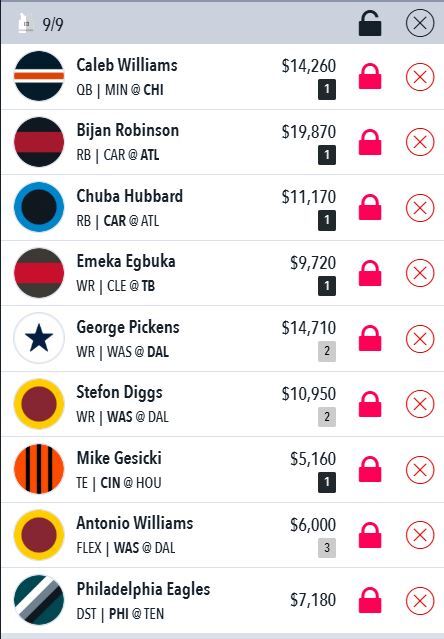
Bijan is the major roster-construction decision. Paying $19,430 for him almost forces us to find value elsewhere, which makes Egbuka and Gesicki particularly appealing. Alternatively, Irving and Hubbard can be paired together to create a balanced build with significantly more money available at receiver.
Correlation remains important. Pickens-Diggs gives us exposure to both sides of Washington-Dallas, while Tampa Bay combinations involving Irving and Egbuka can benefit from the same strong offensive performance. Hurts can be played without a stack because of his rushing upside, while Williams offers enough salary relief to build more aggressively around him.
Most importantly, don't completely rewrite your preseason opinions after one game. Week 1 should refine our expectations, not replace them.
Final Thoughts
Week 1 gave us a huge amount of information, but Week 2 is often where DFS players overreact to it. A player who scored twice isn't automatically a great play, and someone who disappointed isn't suddenly unusable.
That's why Pickens remains interesting after a quiet opener, while the usage behind players such as Bijan, Irving, Hubbard, Diggs, and Schultz give us something tangible to build around.
The biggest question is how much salary to commit at running back. Bijan has arguably the best combination of talent, workload, and matchup on the slate, but using Irving or Hubbard creates significantly more flexibility. Gesicki then provides the extreme value option at tight end if we need another saving.
Build around opportunity, correlate where it makes sense, and don't chase last week's box scores.
Suggested Draftstars NFL Week 2 Lineup