If you follow horse racing for any length of time, you'll hear plenty of talk about "market movers".
A horse might open at $10.00 early in the day, shorten to $7.00 and suddenly be backed into $4.50 as race time approaches. You'll hear commentators say the horse has been "crunched", "smashed" or "heavily backed", and it's easy to assume that somebody must know something.
But what does a "market move" actually mean?
To properly understand market movers, it helps to understand what betting odds represent in the first place. Odds aren't simply numbers chosen by a bookmaker. They represent an implied probability of an outcome occurring, with a bookmaker margin built into the market.
Once you understand implied probability, bookmaker margins and why a racing market doesn't add up to 100%, market moves start to make a lot more sense.
In this guide, we'll explain what market movers actually mean and help you to understand what the betting markets are really telling you.
What Is a Market Mover in Horse Racing?
A market mover is simply a horse whose betting odds have changed significantly since the market opened.
For example:
Opening price: $8.00
Current price: $5.00
That horse has shortened or firmed in the market.
If the opposite occurs:
Opening price: $5.00
Current price: $8.00
The horse has drifted or eased in the market.
There is no official percentage change required for something to be called a market mover. It's simply a commonly used term for a runner experiencing a noticeable change in its betting price.
You can learn more about Fixed Odds, Starting Price, Tote betting and other common racing products in our Horse Racing Betting Types guide.
Betting Odds Are Really Probabilities
The easiest way to understand why a move from $8.00 to $5.00 matters is to stop thinking about odds purely in terms of potential winnings.
Decimal betting odds can be converted into an implied probability with a simple formula:
Implied Probability = 1 ÷ Decimal Odds × 100
For example:
| Odds |
Implied Probability |
| $1.50 |
66.67% |
| $2.00 |
50.00% |
| $2.50 |
40.00% |
| $4.00 |
25.00% |
| $5.00 |
20.00% |
| $8.00 |
12.50% |
| $10.00 |
10.00% |
| $20.00 |
5.00% |
So when a horse shortens from $8.00 to $5.00, the change is more significant than the dollar figures might initially suggest.
At $8.00, the odds represent an implied probability of: 1 ÷ 8 = 12.5%
At $5.00, the implied probability is calculated by: 1 ÷ 5 = 20%
The market has effectively moved from pricing the horse as a 12.5% chance to a 20% chance. That's a substantial reassessment.
There's an important catch, however. Those implied probabilities aren't the market's true assessment of each horse's chance because the bookmaker also has a margin built into the odds.
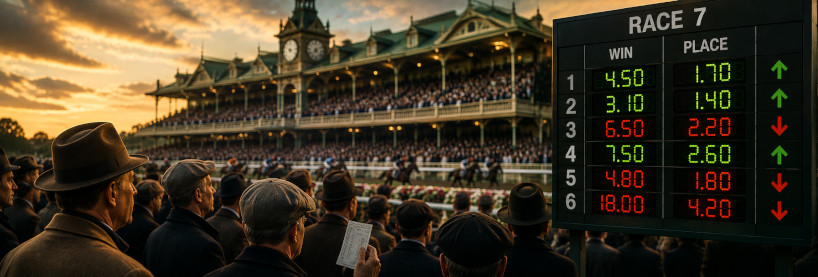
Why Don't Bookmaker Odds Add Up to 100%?
This is one of the most important concepts to understand about betting markets.
Imagine a hypothetical six-horse race with the following odds:
| Horse |
Odds |
Implied Probability |
| Horse A |
$2.50 |
40.00% |
| Horse B |
$4.00 |
25.00% |
| Horse C |
$5.00 |
20.00% |
| Horse D |
$8.00 |
12.50% |
| Horse E |
$10.00 |
10.00% |
| Horse F |
$14.00 |
7.14% |
| Total |
|
114.64% |
Only one horse can win the race, so logically the probability of all possible outcomes should total 100%.
Instead, the bookmaker's prices add up to 114.64%. Where did the extra 14.64% come from?
That's the bookmaker margin, commonly referred to as the overround. It is one of the fundamental ways bookmakers build an advantage into their markets.
Understanding the Bookmaker Margin
If a perfectly fair betting market existed with no bookmaker margin, the implied probabilities of every horse would add up to exactly 100%.
But bookmakers aren't offering odds as a public service.
They generally frame their markets above 100%, meaning the prices offered to punters are shorter than the theoretical "fair odds".
In our example, the market percentage is 114.64%. That doesn't mean the bookmaker is guaranteed to make exactly 14.64% on the race. Real-world bookmaking is more complicated than that, with liabilities, customer betting patterns and changes in prices all affecting the final result. But it does show that the prices contain a built-in advantage for the bookmaker.
This is also why simply converting $2.50 into 40% doesn't necessarily mean the market believes the horse has exactly a 40% chance of winning. We need to account for the margin.
Removing the Bookmaker Margin
We can get a rough estimate of the market's underlying probabilities by normalising the prices back to 100%.
Using our fictional 114.64% market:
| Horse |
Odds |
Implied Probability |
Margin-Adjusted Probability |
| Horse A |
$2.50 |
40.00% |
34.89% |
| Horse B |
$4.00 |
25.00% |
21.81% |
| Horse C |
$5.00 |
20.00% |
17.45% |
| Horse D |
$8.00 |
12.50% |
10.90% |
| Horse E |
$10.00 |
10.00% |
8.72% |
| Horse F |
$14.00 |
7.14% |
6.23% |
| Total |
|
114.64% |
100.00% |
This gives us a better idea of what the market is really saying.
Horse A's $2.50 price implies a raw probability of 40%, but once we remove the margin proportionally, its estimated market probability is closer to 34.9%.
A fair price corresponding with a 34.9% chance would be approximately: 1 ÷ 0.3489 = $2.87
Yet the bookmaker is offering $2.50. That's the margin at work.
Note: proportionally normalising a market is a useful simplified way of illustrating the concept. In real betting markets, bookmaker margin isn't necessarily distributed evenly across every runner.
Why Do Horse Racing Odds Move?
Now that we understand what the odds represent, market movements become much easier to understand.
A price move essentially means the betting market is reassessing the probability of a horse winning. There are several reasons this can happen.
Money Enters the Market
The most obvious reason is betting activity.
If a bookmaker takes significant bets on one horse, it may shorten that runner's price to reduce its potential liability and make the odds less attractive to further bettors.
At the same time, other runners may drift.
The amount of money required to move a price can vary significantly depending on the race and when the bet is placed.
A relatively modest wager might influence an early market with little liquidity, while substantially more money may be required to move the market shortly before a major Group 1 race.
Respected Money
Not all betting activity will necessarily be treated equally.
Bookmakers build profiles of betting activity and may react quickly when wagers come from customers they consider particularly well-informed or successful in certain markets.
This is sometimes referred to as sharp money. That doesn't mean the bettor knows the result of the race. It simply means the bookmaker may respect the opinion behind that particular wager enough to reconsider the price.
New Information
Racing markets are constantly processing information. That might include:
- A change in track conditions
- Jockey changes
- Gear changes
- Weather
- How the track is playing earlier in the meeting
- A perceived leader or on-pace bias
- Other horses being scratched
- Information from previous races involving related form lines
As new information becomes available, punters and bookmakers reassess the chances of each runner. The odds then move accordingly.
Other Bookmakers Move Their Prices
Bookmakers don't operate in isolation.
If a horse suddenly shortens significantly across the wider market, other bookmakers are unlikely to simply leave a much bigger price available indefinitely.
They may adjust their own prices even if they haven't personally taken significant bets on that runner. This is why a move can quickly spread across the market.
Betting exchanges can also provide useful information because prices are created through customers backing and laying against one another rather than a bookmaker simply posting a price. We have a separate guide to Understanding Betfair Markets if you'd like to learn more about how exchange markets work.
What Happens to the Market After a Scratching?
Scratchings are another reason racing prices can move, but these shouldn't necessarily be confused with genuine betting support.
Suppose the $3.00 favourite is scratched from a race. A significant percentage of the market has suddenly disappeared, so the remaining horses will generally shorten.
A runner moving from $6.00 to $4.80 following the favourite's scratching doesn't necessarily mean money has arrived for that horse. Its probability has changed simply because one of its major rivals is no longer competing. This is an important distinction when assessing market movers. Always consider why the price has changed rather than looking at the movement alone.
Does a Market Mover Mean the Horse Will Win?
Absolutely not.
This is perhaps the biggest misconception surrounding market movers.
If a horse has shortened from $10.00 to $5.00, it can be tempting to think:
"Someone must know something."
But the horse is still $5.00.
Even using the raw implied probability, that's only a 20% chance. After allowing for bookmaker margin, the market's underlying assessment could be lower again.
In other words, even if the market move is completely justified, the horse can still be expected to lose considerably more often than it wins at that price.
Market moves can be informative. They're not guarantees.
Why Early Market Moves Can Be Misleading
Market moves can look particularly dramatic when betting first opens.
Early racing markets often have less money in them, meaning bookmakers can be more cautious with their prices and smaller amounts of money may produce larger moves.
Consider:
Horse opens $15.00
Shortens to $8.00
Eventually starts $11.00
Anyone looking only at the opening price and the $8.00 quote might describe that horse as being "smashed".
But by race time, the market has partially corrected itself.
This is why the starting price can be useful when looking back at whether you secured a good price.
Our guide to Fixed Odds vs Tote betting explains some of the different options available to racing punters and why the timing of your bet can matter.
Is It Too Late to Back a Horse After It Shortens?
This is where things become more interesting. Suppose you've done the form and believe a horse should be approximately a $4.00 chance. That means you've assessed its probability of winning at around 25%.
You check the market and see:
Bookmaker A: $5.50
Bookmaker B: $5.00
Bookmaker C: $4.80
You might consider those prices attractive relative to your own assessment.
But then the horse is heavily backed and every bookmaker moves to $3.50. Has the horse suddenly become a better bet because everyone else is backing it?
Not necessarily.
The horse's actual ability hasn't changed simply because its price has shortened. In fact, if you still believe its fair price is $4.00, then $3.50 is now below the price you were prepared to take.
This highlights one of the most important concepts in betting - picking the winner and finding a good bet are not necessarily the same thing.
Why Comparing Odds Between Bookmakers Matters
This is also why it can be worthwhile comparing the price at the best Australian sportsbooks rather than automatically betting with the same bookmaker every time.
Imagine you've decided to back a horse and find these prices:
| Bookmaker |
Odds |
| Bookmaker A |
$4.20 |
| Bookmaker B |
$4.00 |
| Bookmaker C |
$3.80 |
The horse has exactly the same chance of winning regardless of where you place the bet.
But your potential return is different. A $100 winning bet at:
$4.20 returns $420
$4.00 returns $400
$3.80 returns $380
Over one bet, $20 or $40 might not seem particularly significant. Repeated over hundreds of bets, consistently taking better prices can make a substantial difference to your overall returns.
This is one reason experienced racing punters often maintain accounts with multiple bookmakers rather than relying on a single operator.
Market Movers vs Value
Ultimately, a market mover tells you what has happened to the price. It doesn't tell you whether you should bet.
A horse shortening from $8.00 to $5.00 may have attracted significant support and the market may now consider it a much stronger winning chance.
But the important question for a punter is: What do I think the horse's true chance of winning is, and are the available odds better than that probability?
If you think the horse should be $4.00 and can still get $5.00, you may believe there's value in the price. If you think it should be $6.00 and the market has shortened to $5.00, following the money doesn't suddenly make $5.00 attractive. That's the fundamental difference between identifying the most likely winner and identifying value.
Don't Forget Bankroll Management
Understanding probabilities and prices doesn't eliminate the uncertainty involved in horse racing.
A horse you assess as a genuine 25% chance of winning should still lose approximately three times out of four if your assessment is correct.
Losing runs are therefore an unavoidable part of betting.
Staking more simply because you're confident about a market mover — or chasing a horse because "everyone is on it" — doesn't change its probability of winning.
For more on controlling bet sizes and dealing with variance, read our guide to Sports Betting Bankroll Management.
Putting It All Together
Market movements are one of the most interesting parts of horse racing betting because they provide a live indication of how the market's assessment of a race is changing.
But simply following horses that shorten in price isn't a betting strategy on its own. The key concepts to remember are:
- Betting odds can be converted into implied probabilities.
- A $5.00 price represents a raw implied probability of 20%.
- Bookmaker markets generally add up to more than 100% because a margin is built into the prices.
- A horse shortening in price means its implied probability has increased.
- Odds can move because of betting activity, new information, scratchings or changes elsewhere in the market.
- A market mover isn't guaranteed to win.
- A shorter price isn't automatically a better bet.
- Comparing prices across bookmakers can make a meaningful difference over time.
- Ultimately, the important question isn't simply "Will this horse win?" but "Is the available price better than its true chance of winning?"
Once you start viewing odds as probabilities rather than just potential payouts, racing markets begin to look very different.
Instead of seeing that a horse has been "smashed from $8 into $5", you can see what's really happened: a market has significantly reassessed the horse's chance of winning.
Whether $5 is still a good price is another question entirely.
For your next bet, check out the latest Horse Racing Tips at Before You Bet, where our racing team provides regular previews, form analysis and selections from major meetings around Australia.